AVRs for brushless alternators
Brushless alternator AVRs regulate excitation so a generator can hold usable output voltage as load rises and falls. We help match replacement units for standby and prime sets from small site machines to larger fixed installations.
What a brushless alternator AVR does
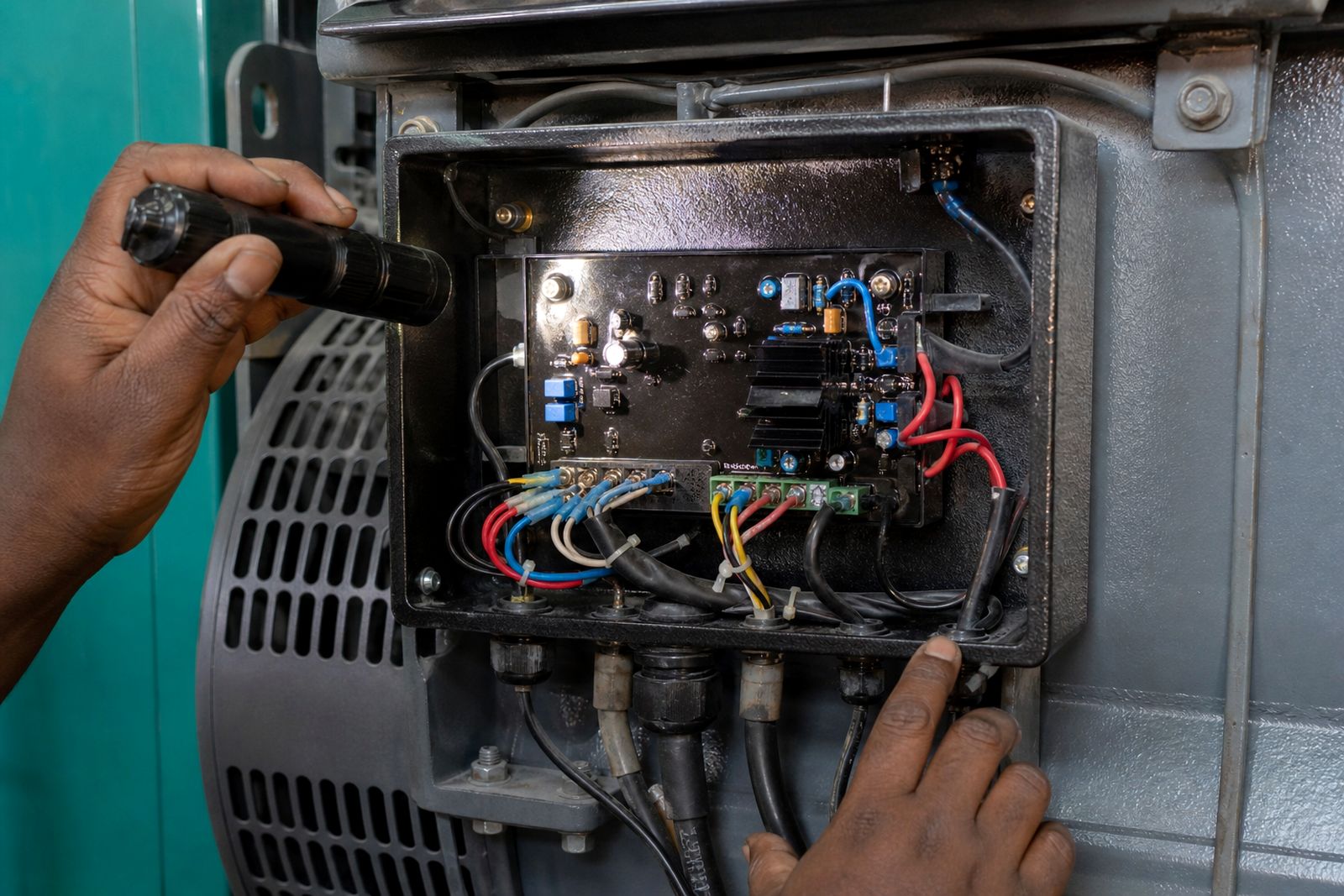
An automatic voltage regulator controls the current sent to the exciter side of a brushless alternator. That control keeps output voltage within a workable band while the engine speed stays at its rated rpm. On standby sets this matters when pumps, compressors, lights and office loads switch in and out. On prime units it matters across longer running periods where heat, dust and vibration can expose a weak regulator quite quickly.
A failed or incorrect AVR can show up as no output, high voltage, low voltage, unstable voltage or hunting under load. In some cases the alternator itself is sound and only the regulator has failed, but a proper match still depends on the alternator type, sensing arrangement and exciter circuit. A brushless machine is not one broad pattern, small wiring differences matter more than people expect.
- Used on many standby and prime diesel generator alternators.
- Common on units with self-excited or separately sensed regulation.
- Matched by regulator layout, terminals, voltage sensing and alternator data.
Common AVR layouts and working limits
We handle common AVR patterns used on single-phase and three-phase brushless alternators. Some are simple half-wave or full-wave regulator boards for smaller sets, while others have trim pots for voltage, stability, under-frequency roll-off and protection functions. The right choice is not only about physical size. Terminal marking, sensing voltage, exciter resistance range and whether the unit needs an external droop or current transformer input all affect compatibility.
Most brushless AVR replacements fall into a practical range from compact enclosed modules to open heat-sink boards fitted inside the alternator terminal box. Working limits vary by design, but the usual checks include sensed output voltage, frequency reference, exciter field current capacity and ambient heat. In Wadeville workshops and plant rooms around Gauteng, heat build-up inside a poorly ventilated canopy can shorten AVR life, even where the generator itself still starts and runs well.
- Single-phase and three-phase sensing options.
- Units for 50 Hz applications, with under-frequency protection where fitted.
- Exciter output ratings differ, so field current and resistance must be checked.
- Some versions need a separate fuse, suppression component or link setting.
Where these AVRs suit the job
Brushless alternator AVRs suit standby generators at homes, farms, workshops, retail premises and light industrial sites where the machine must hold a stable output for ordinary building loads. They are also used on prime or longer-run sets that feed pumps, basic process loads and mixed site circuits. A suitable AVR can restore proper regulation where the old unit has burnt, drifted out of range or become erratic after moisture and dust exposure.
There are limits though. An AVR will not correct engine governor faults, damaged rotating diodes, failed exciter windings, carbon tracking on terminals or poor insulation in the main stator. It also will not solve a frequency problem caused by incorrect engine speed. If a set has severe overload issues or repeated short circuits, the regulator may fail as a symptom rather than the root cause.
- Good fit for standby sets that have lost voltage control.
- Suitable for many fixed and mobile brushless alternators.
- Not a cure for engine speed faults or alternator winding damage.
Installation notes that matter on site
AVR replacement should be done with the generator isolated and by a qualified electrician or generator technician familiar with alternator wiring. Terminal positions, link settings and polarity on field connections must be checked before power-up. A regulator that looks similar can still be wired differently and that mistake can damage the new unit very quickly.
Site conditions also matter. Vibration mounts in poor condition, loose terminal screws, dirty cooling paths and water ingress into the alternator terminal box all shorten service life. If the generator feeds a changeover panel or automatic mains failure system, those switching components must also be checked when voltage complaints are investigated, because the AVR is not always the only fault on the set.
- Confirm alternator model details from the nameplate before fitting.
- Check all terminals, field wiring, rotating diodes and residual magnetism.
- Set voltage and stability trims carefully after installation.
- Any wiring, testing and changeover work must be done by a qualified electrician.
Care and fault patterns we see often
Dust, oil vapour, coastal humidity and battery charger faults can all affect AVR life. In coastal towns the mix of salt air and condensation often leaves green corrosion on fine terminals, while inland workshop sets can suffer from heat and conductive dust. Small signs like scorched spade connectors, loose sensing leads or a drifting output voltage under a steady load often point to trouble before the set drops output completely.
It helps to keep the alternator end dry and reasonably clean, and to inspect terminal tightness during routine service work. If a machine has stood for a long period, low residual magnetism can mimic regulator failure. This catches people out often, especially on standby units that only run for short tests.
- Keep the terminal box dry and free of dust build-up.
- Inspect spade terminals, fuses and small link wires during service intervals.
- Watch for voltage drift after the alternator warms up.
- Investigate repeated AVR failures for wider alternator or site faults.
What to send when asking us to match an AVR
The best matches happen when we can compare the old regulator, the alternator details and the generator application together. A clear photo set saves time and avoids ordering by guesswork. If the old AVR is missing or too badly burnt to read, the alternator nameplate and internal wiring photos usually still give enough to start narrowing it down.
Please send your details through our contact form with as much of the following as you can gather from site.
- Clear photos of the old AVR front and back.
- Alternator nameplate photo and generator set nameplate photo.
- Terminal markings and wiring positions before removal.
- Single-phase or three-phase output, and rated voltage.
- Generator use: home standby, farm, workshop, pump set or business premises.
- Fault symptoms such as no output, over-voltage, low voltage or unstable reading.
If the unit has had previous rewiring or non-standard modifications, mention that up front. It helps, because mixed wiring colours and moved links are common on older sets and can mislead even a careful visual match.
What our Generator Parts customers say
Verified Google reviews
Questions we get asked
Can I replace a brushless alternator AVR with one that looks similar?
Not safely by appearance alone. Terminal functions, sensing voltage, field output and link settings must match the alternator, otherwise the regulator can fail or the set can over-voltage.
Will a new AVR fix low voltage on every generator?
No. Low voltage can also come from low engine speed, failed rotating diodes, poor residual magnetism, damaged windings or loose sensing wires. The regulator is only one part of the circuit.
What photos help most when I enquire?
Send the alternator nameplate, the old AVR front and back, terminal markings, and one wider photo showing how the regulator sits in the terminal box. Clear close-ups make matching far easier.
Also worth a look
Tell us about the job
Send sizes, materials and where you are through our contact form, and we will come back with the practical options.
Open the contact form