

Sensors and senders
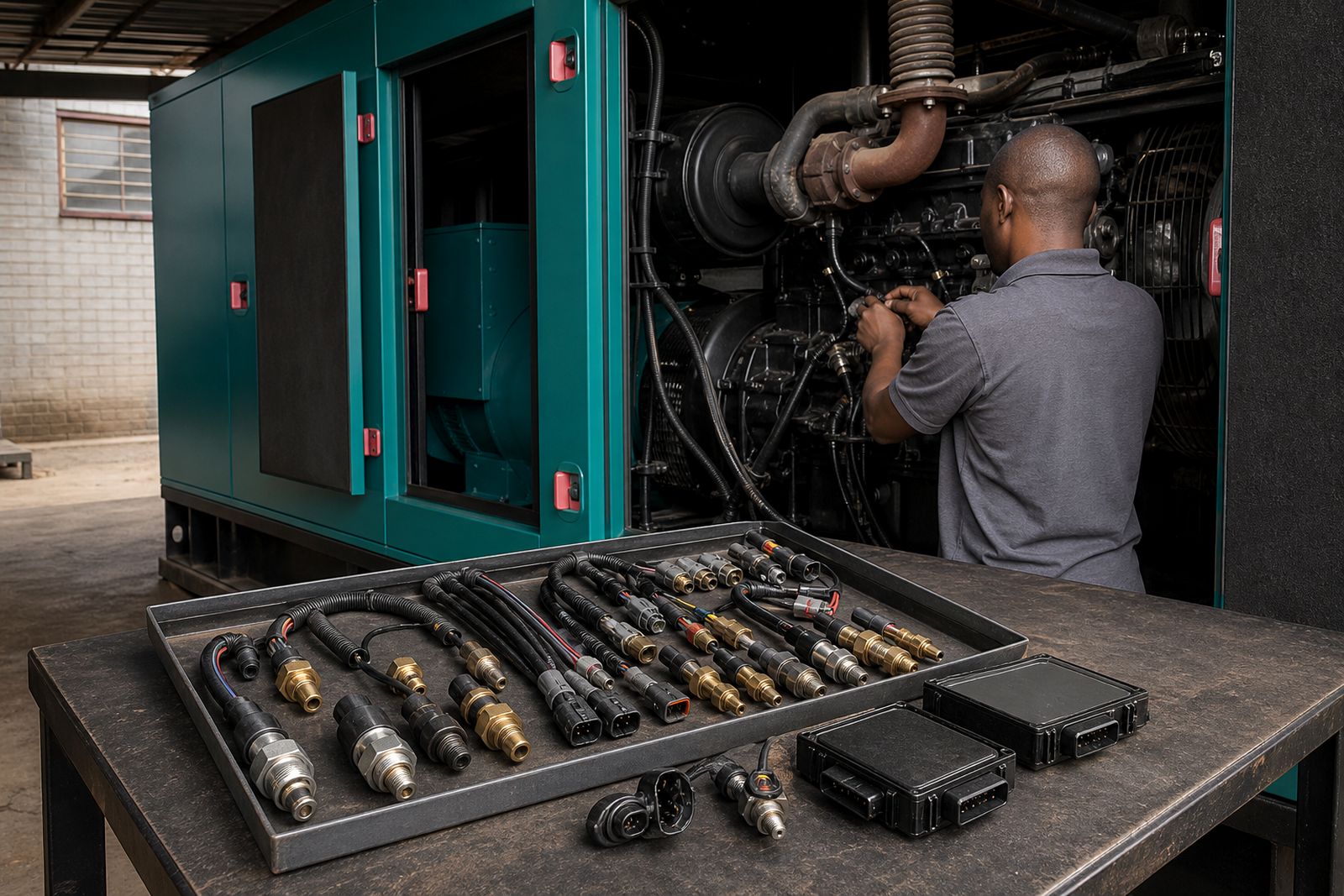
Generator sensors and senders give the controller the readings it needs to start, protect and shut down a set correctly. We supply common oil pressure, coolant temperature, fuel level and speed sensing parts for small portable units and larger standby machines.
What these parts do on a generator
A sensor or sender converts a physical condition on the engine or tank into a signal the controller can read. On most sets that means oil pressure for shutdown protection, coolant or cylinder head temperature for overheat alarms, fuel level for tank indication, and engine speed for frequency control or overspeed protection.
Some parts switch at a fixed point, while others give a changing resistance or voltage across the operating range. That difference matters. A low oil pressure switch cannot replace a resistive oil pressure sender, and a magnetic pickup for speed input cannot stand in for a charging alternator signal wire. Getting the correct type first saves a lot of chasing later, especailly where a controller fault is actually a sensor mismatch.
- Pressure switches for alarm or shutdown circuits.
- Resistive oil pressure senders for gauges and controllers.
- Temperature switches and temperature senders.
- Fuel level senders for tank depth and panel indication.
- Magnetic pickups and speed sensing items for engine RPM input.
Common types, threads and signal ranges
Generator engines use several body sizes and thread forms, so nameplate details alone are not always enough. We normally ask for clear photos of the existing part, the connector style, any markings on the hex or body, and a measurement of the thread outside diameter if the old part is out of the engine. For tank senders, the mounting pattern and rod or float length are just as important as the resistance range.
Working limits vary by engine and controller, but these are the ranges most customers ask for:
- Oil pressure senders in low and medium ranges suited to small petrol engines and diesel standby sets.
- Temperature senders matched to water cooled engines, and switch types for high temperature trip points.
- Fuel level senders in common resistance ranges used by generator panels and separate gauges.
- Speed pickups with different body lengths, thread sizes and air gap requirements to the flywheel teeth.
- Single terminal and dual terminal versions, plus earth return through the body where required.
If the old part has failed completely and no markings are visible, controller model details and a photo of the engine mounting point often narrow it down a lot.
Where sensors and senders suit the job
These parts suit standby generators at homes, workshops and offices, farm sets running pumps or cold rooms, and portable units where an engine protection module needs a proper input signal. In Wadeville we often help customers replacing oil pressure and temperature parts after routine servicing, vibration damage or wiring repairs. Across other provinces, courier orders are usually for machines in remote yards where the service technician needs the correct thread and signal the first time.
They do not suit every fault. If a generator has low frequency because the engine governor is unstable, changing the speed sender will not cure that. If a panel shows empty fuel with the tank half full, the issue may be a gauge range mismatch or a bad earth at the tank flange, not the sender itself. It helps to describe the symptom clearly and whether the fault is constant or only appears after warm-up.
- Good for shutdown protection circuits and alarm inputs.
- Useful when a gauge or controller reading is clearly wrong.
- Suitable for service stock on farms and workshop maintenance shelves.
- Not a fix for damaged wiring looms, leaking radiators or worn mechanical governors.
Fitting points, wiring and site requirements
Most engine mounted senders fit into an existing tapped port on the block, filter housing, thermostat housing or radiator circuit. The mating thread must be correct, and the body needs enough clearance around filters, manifolds and engine covers. Magnetic pickups need the right insertion depth and an air gap set to the flywheel ring gear, otherwise the controller may lose RPM signal while cranking.
Electrical work must be done by a qualified electrician or generator technician where panel wiring and changeover circuits are involved. We do not do electrical installation. On sets near the coast or in washdown areas, corrosion at terminals and plugs is common, so it is worth checking the connector and harness before fitting a new part. A new sender fitted onto a dirty earth path can still read badly.
- Check thread size, pitch and sealing method before tightening.
- Confirm whether the part earths through the body or needs a separate terminal.
- On tank senders, measure tank depth in millimetres and the bolt pattern.
- On speed pickups, note tooth count if the controller setup calls for it.
Care and fault tracing before replacement
Sensors live in heat, oil mist, vibration and diesel grime, so many failures start outside the part itself. Loose spade terminals, cracked insulation near the crimp, contaminated plugs and thread sealant on the wrong surfaces can all upset readings. Before replacing a sender, it is worth checking for clean supply voltage, a sound earth path and continuity back to the panel.
Where a fault appears only under load, note whether the panel shows a steady wrong reading or a sudden jump. A stable but inaccurate reading often points to the wrong resistance range, while a flickering value can indicate vibration, a broken conductor or a weak terminal. Keep spare parts dry and boxed until needed, and do not leave speed pickups rolling around in a steel toolbox where the tip can pick up metal filings.
What to send with your enquiry
The quickest way to match a sensor or sender is to send a small set of clear details through our contact form. Even where the old part is badly worn, a few useful photos usually tell us more than a long description.
- Generator nameplate photo and, if visible, engine plate photo.
- A clear photo of the old part from the side and terminal end.
- Any numbers stamped on the body, terminal or flange.
- Thread outside diameter, thread type if known, and spanner size across the hex.
- For fuel level parts, tank depth and the resistance range from the gauge or controller if known.
- A short note on the fault, such as no start, false low oil pressure, overheat trip, or erratic fuel reading.
If the machine has had controller changes or rewiring in the past, mention that too. Mixed parts are common on older standby sets, and that one detail can prevent the wrong sender being matched.
What our Generator Parts customers say
Verified Google reviews
Questions we get asked
Can I replace any oil pressure sender with one that fits the thread?
No. The thread is only one part of the match. The pressure range, signal type, terminal layout and earth arrangement must suit the gauge or controller.
Do you supply complete generator sets or do installation work?
No. We supply generator spares only. Wiring, panel work and changeover connections must be handled by a qualified electrician.
What if the old sensor has no readable number on it?
Send photos of the part in place, the mounting point, the generator nameplate and the controller. Thread measurements and a note on the fault usually help narrow it down.
Also worth a look
Tell us about the job
Send sizes, materials and where you are through our contact form, and we will come back with the practical options.
Open the contact form